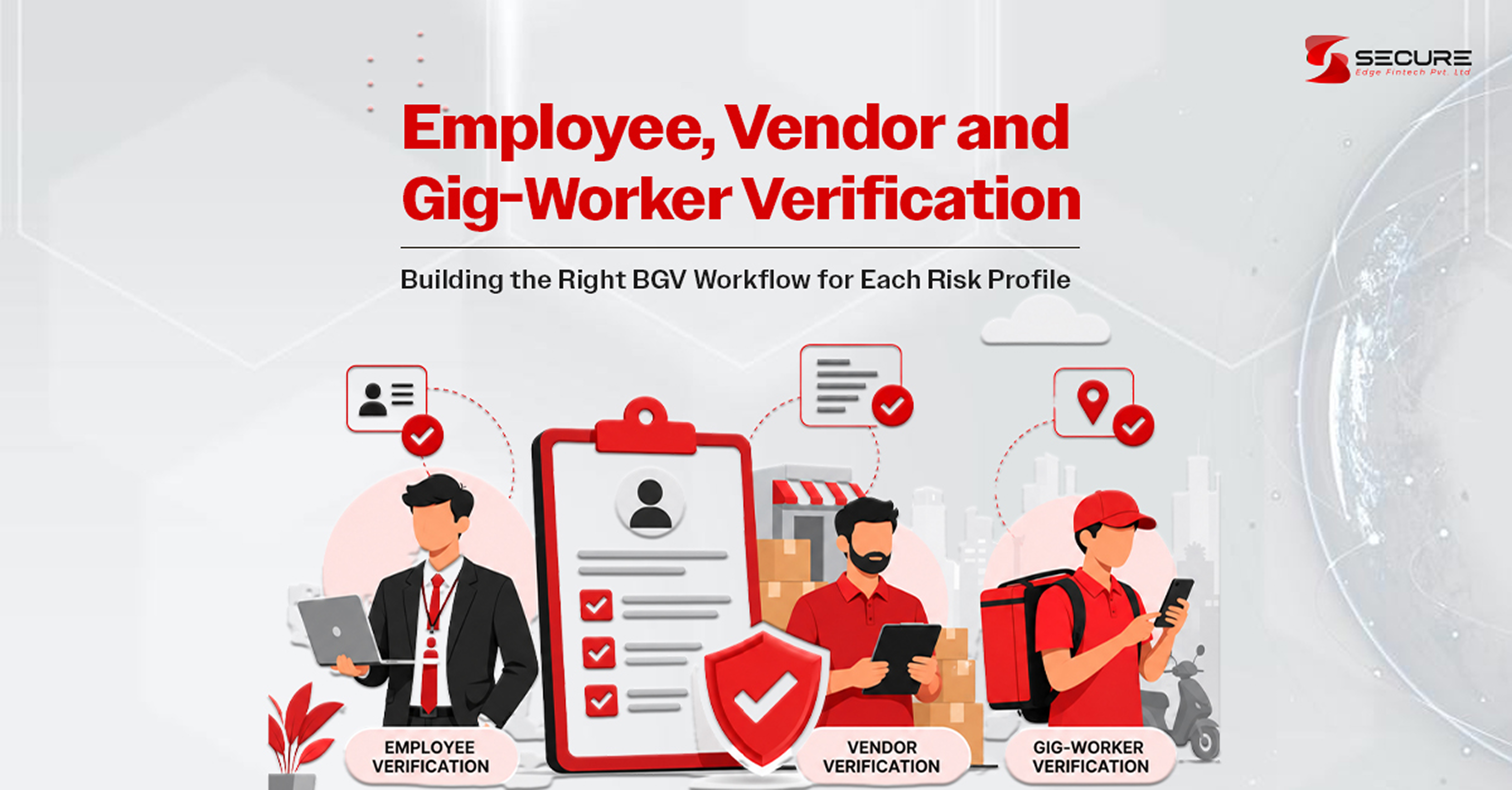
Employee, Vendor and Gig-Worker Verification: Building the Right BGV Workflow for Each Risk Profile
Most background verification programs start with a policy document that says everyone gets "standard checks" - identity, address, criminal record, maybe education. It reads fine until you actually map it against the people it applies to. A relationship manager with login access to core banking and a customer's account balance is not the same risk as a delivery partner picking up a cash repayment once a week, and a BPO agent handling customer calls for three different clients is not the same risk as either. Run all three through one workflow and you get the worst of both outcomes: the high-trust employee role gets screened no more rigorously than it has to be, and the gig role gets an expensive, slow check that adds friction to onboarding without buying you much additional protection.
This post assumes you already know what background verification covers and why BFSI institutions run it - if you want that grounding first, our broader guide to background verification for BFSI covers the fundamentals. Here, the question is narrower and more practical: given that a bank, NBFC, or fintech onboards people across wildly different risk tiers - permanent employees, third-party vendor staff, and gig or last-mile partners - how do you actually design a BGV workflow for each, and how do you keep that from turning into three unrelated manual processes?
Workflow 1: Permanent Employees in High-Trust Roles
Think about who this covers in a typical bank or NBFC: a teller handling cash and customer instructions, a relationship manager with visibility into account balances and personal data, an ops or IT staffer with admin access to core banking systems, anyone in a role where a single bad actor could do real, sustained damage before anyone noticed. This is where screening should go deepest, and where cutting corners is the costliest mistake.
A defensible screening bundle for these roles typically covers:
Identity verification: confirming the candidate is who their documents say, cross-matched across the ID proofs submitted.
Address verification: current and sometimes permanent address, since a mismatch or an address that doesn't check out is a basic red flag worth chasing down before day one.
Employment history across multiple previous employers: not just the most recent one. Gaps, inconsistencies in dates or designations, or an employer that doesn't confirm the tenure claimed are exactly the kind of thing a single-employer check misses.
Education verification: confirming degrees and institutions claimed, particularly for roles where a specific qualification was part of the hiring decision.
Criminal record checks: run through the appropriate court and police record databases available for the candidate's address history.
Some form of financial background signal, for roles handling money or credit decisions: the specifics vary by institution and role, but broadly this means checking for financial red flags relevant to a position with fiduciary responsibility - framed as a risk signal to weigh, not an automatic disqualifier, and reviewed alongside everything else rather than in isolation.
Don't stop at hiring
Here's the part most BGV programs skip: a clean check at hiring tells you nothing about the person two years into the role. Someone's financial situation, legal record, or personal circumstances can change well after onboarding, and for roles with ongoing access to money or sensitive data, that's exactly the population where periodic re-verification matters most. An annual or biennial refresh of the criminal record and financial signal checks - not the full bundle every time, since employment history and education rarely change - catches the risk that accrues after day one, which point-in-time hiring checks structurally cannot.
Workflow 2: Third-Party Vendors and Contractors
Vendors are where a lot of BGV programs quietly fall apart, because the risk sits at two levels that need two different kinds of checks. Think of an IT vendor with a support contract that includes remote access to your systems, a BPO handling inbound or outbound customer calls, or a cash logistics or physical security vendor with staff inside your branches. Screening only the company, or only the individuals it sends, leaves half the risk unaddressed.
Entity-level checks
Before any of the vendor's staff touch your systems or premises, you want confidence the vendor itself is a real, currently operating, legitimately registered business - not a shell that exists to subcontract work down a chain you have no visibility into. This is conceptually the same territory as KYB/business verification checks used in lending onboarding: confirming registration status, legal standing, and that the entity you're contracting with is who it claims to be, rather than taking a signed MSA at face value.
Individual-level checks, scaled to access
Once the entity itself checks out, the staff the vendor actually deploys need screening scaled to what access they get, not a flat policy applied regardless of role. A field technician who never touches a live system needs less than a support engineer with remote admin credentials to your core banking environment. A cash logistics guard physically present in a branch needs a different bundle again - identity, address, and criminal record checks weigh more heavily there than employment history at a previous IT job would. The point is that "vendor staff" isn't one risk tier; it's however many tiers your vendor relationships actually create, and the check bundle should follow the access, not the vendor's job title for the role.
Workflow 3: Gig and Last-Mile Roles
Gig and field roles - a cash-pickup delivery partner for a fintech's collection service, a doorstep-onboarding field agent, a last-mile logistics partner - sit in a genuinely different operating reality. Volumes are higher, churn is higher, and the per-person screening budget and time window are both much smaller than for a permanent hire. Trying to run the full employee-tier bundle on this population isn't just expensive, it slows onboarding to the point where you lose the candidates you actually wanted.
The practical answer isn't less screening, it's a different shape of screening: a lighter, faster initial check - identity, address, and a basic criminal record check, ideally returned in minutes rather than days - paired with ongoing monitoring after onboarding rather than one exhaustive check that never gets revisited. This matters more than it sounds, because a gig worker's risk profile isn't fixed at the moment they onboard. Someone can pass a clean check on day one and pick up a criminal record eighteen months into an active gig relationship with your platform, and if your only checkpoint was hiring, you'll never know.
This is also where the volume argument cuts in your favor rather than against you: a fast, API-driven initial check at high volume, backed by periodic automated re-checks, is genuinely more affordable per person than a slow, thorough one-time manual check ever was - which is the whole reason this tier can be screened at all without the economics falling apart.
Comparing the Three Workflows
| Role Type | Typical Screening Depth | Re-verification Cadence |
|---|---|---|
| Permanent, high-trust employee | Identity, address, multi-employer history, education, criminal record, financial signal for money/access roles | Annual or biennial refresh, especially for criminal and financial signals |
| Third-party vendor / contractor staff | Entity-level KYB on the vendor, plus individual checks scaled to system or premises access | Tied to contract renewal or access-level change, whichever comes first |
| Gig / last-mile partner | Identity, address, basic criminal record - fast turnaround | Continuous or periodic automated monitoring rather than a one-time check |
Why Continuous Monitoring Matters Across All Three Tiers
Every tier above has the same underlying problem: a background check is a snapshot, and people's circumstances don't freeze at the moment you took it. The permanent employee whose finances were clean at hiring can end up under real pressure three years later. The vendor whose staff passed muster on day one can rotate in new personnel without you noticing. The gig partner who looked fine on a Tuesday can pick up a record on a Friday eighteen months later. Point-in-time checks answer "was this true when we asked," not "is this still true now" - and for BFSI institutions, the second question is the one that actually protects you.
The reason continuous monitoring wasn't standard practice for years is straightforward: manual, agency-based re-verification is slow and expensive enough that re-running it on your entire workforce, let alone your vendor and gig populations, was never realistic. Nobody was going to pay an agency to re-run a full manual check on ten thousand delivery partners every quarter. API-based BGV changes that math directly - a re-check that pulls structured records from the same databases the original check used costs a fraction of a manual re-investigation and returns in minutes, not weeks. That's what makes "periodic, not just point-in-time" an actually affordable policy instead of a nice idea in a compliance deck.
Orchestrating This: A Rules-Based Workflow, Not a Manual Process
None of this works if every hire, vendor onboarding, and gig sign-up routes through the same manual checklist with someone deciding by feel which checks to run. The practical fix is a rules-based workflow that maps role or access tier to a specific check bundle automatically, so the decision gets made once - at the policy level - instead of case by case.
In practice that looks like: role or access level is set at onboarding → workflow engine matches that tier to a predefined check bundle → API calls fire the relevant checks (identity, address, employment, education, criminal record, entity-level KYB where applicable) → results come back structured and get cross-matched automatically → clean passes move straight through, flagged or ambiguous results route to human review → re-verification triggers get scheduled per tier going forward, so nobody has to remember eighteen months from now that a particular employee is due for a refresh.
You still want a human in the loop - but for judgment calls on ambiguous results, not for deciding which checks a given role needs every single time. That decision belongs in the workflow rules, made once, applied consistently, and revisited only when your risk policy changes rather than when someone forgets a step.
Frequently Asked Questions
How often should employee background checks be repeated after hiring?
There's no single universal cadence, but a common pattern for high-trust roles - anyone with system access to core banking, customer data, or funds movement - is an annual or biennial re-check, with criminal record and financial signal checks refreshed more often than education or employment history, which rarely change once verified. Lower-trust roles can go longer between cycles, but "never after hiring" is the wrong default for anyone whose access level could plausibly change over time.
What's different about screening a bank employee versus a gig-economy delivery partner?
Mostly depth and access, not the checks themselves. A bank employee with access to core systems or customer funds typically needs identity, address, multi-employer history, education, and criminal record checks, refreshed periodically. A delivery or field partner usually needs identity, address, and a basic criminal record check, done fast, paired with ongoing monitoring rather than an exhaustive one-time screen - because the role's access is narrower and the population churns faster.
Should vendor screening cover the company or the individual staff, or both?
Both, and skipping either half leaves a real gap. Company-level checks confirm the vendor itself is a legitimate, currently registered business - not a shell entity subcontracting work to whoever's cheapest that month. Individual-level checks cover the actual staff who'll have system or premises access, scaled to what that access lets them do.
Can background verification workflows be fully automated, or does every check need human review?
The data pulls - identity match, address confirmation, database record lookups - can run entirely through API with no human in the loop for a clean pass. Where a check comes back ambiguous or flagged (a partial name match, a record that needs context), that's where human review earns its place. The goal isn't removing people from the process, it's making sure they're only spending time on the cases that actually need judgment.
How do you decide how much screening depth a particular role actually needs?
Start from access, not job title. Ask what systems, funds, customer data, or premises the role can reach, and how much damage a bad actor in that seat could realistically do. A back-office role with no system access needs less than a field agent who collects cash, even if the org chart calls one of them more senior. Mapping roles to access tiers first, then attaching a check bundle to each tier, keeps the decision consistent instead of ad hoc.
Conclusion
Uniform background verification feels like the safe, defensible choice, but in practice it just means you're overpaying to screen your lowest-risk roles and underpaying attention to your highest-risk ones. The workable answer is tiering the workflow to the actual access a role carries - deep and periodic for high-trust employees, entity-plus-individual for vendors, fast-and-monitored for gig and last-mile partners - and running it through rules rather than manual judgment each time. An API layer flexible enough to support that kind of tiered, rules-based BGV workflow is exactly what Verify Edge is built for. If you're designing or rebuilding a screening workflow across employee, vendor, and gig populations, get in touch with SecureEdge and we can walk through how the check bundles and routing would map to your specific roles.